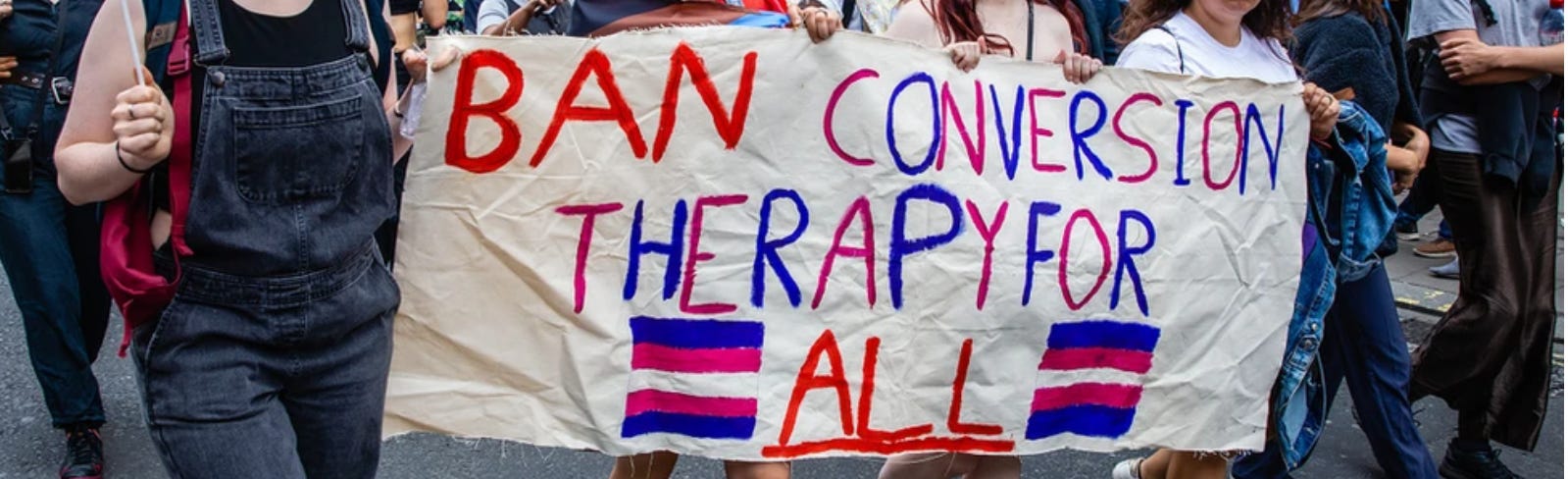
'Conversion therapy' bans
A politican's graveyard?

Politicians are once again talking about a ‘trans inclusive’ ban on conversion therapy. We’re hosting a piece by Peter Jenkins of Thoughtful Therapists laying out why many mental health professionals believe it’s a weak and dangerous idea. Peter this year left his professional association, the British Association of Counselling and Psychotherapy, over its approach to sex and gender identity. Thoughtful Therapists is made up of counsellors, psychotherapists and psychologists campaigning against the imposition of gender identity theory on therapy practice.
*****************************************
It all started back in 2010 with a journalistic sting. An ostensibly troubled gay man goes for therapy from a counsellor, seeking help with his sexual attraction to men. The counsellor seems to rise to the bait, unaware that the session is being taped.
“She says that at the heart of homosexuality is a ‘deep isolation’, which is, she says, ‘where God needs to be’”.
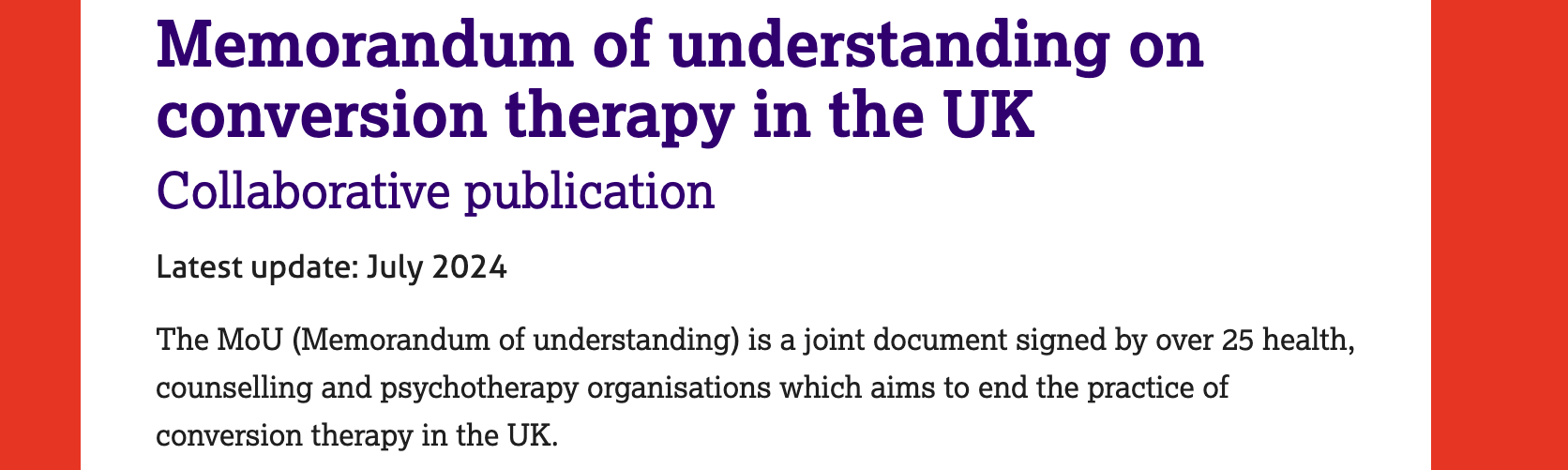
Snap! The trap closes, resulting in a hostile press write-up in The Independent. The journo/’client’ makes a successful professional complaint against the counsellor. The professional association, the British Association for Counselling and Psychotherapy (BACP) issues a series of stern warnings to members not to practise ‘gay conversion therapy’.
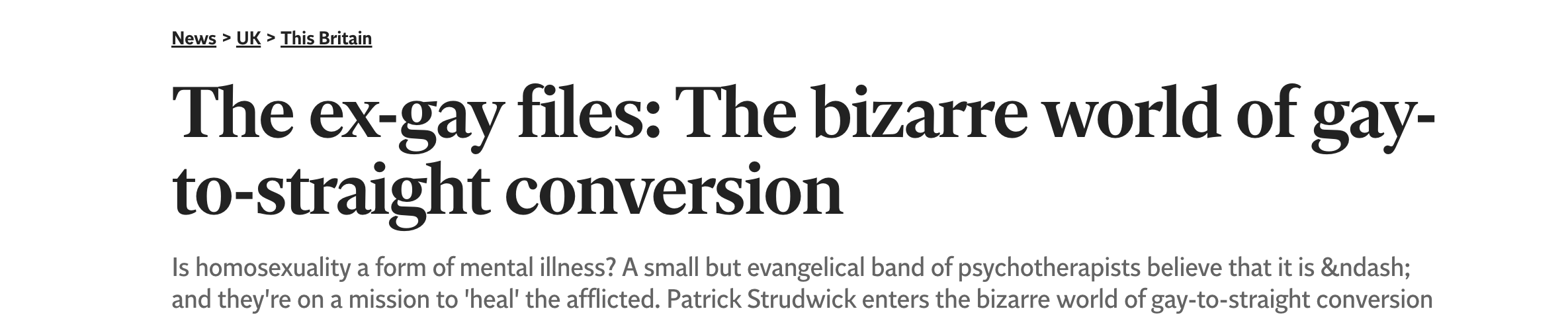
By 2015, BACP joins a host of therapy associations and employers in a policy compact, the Memorandum of Understanding on Conversion Therapy (MOU). The MOU closes its grip on most therapy, medical and psychiatric bodies in the UK. Conversion therapy is bad, not to be debated, and needs to be stamped out via a criminal legal ban.
This is despite a worrying lack of hard evidence that conversion therapy really is rife within the world of therapy, as distinct from within faith settings and cults. Then, in a master-stroke, and with very little debate, the MOU was extended overnight to cover conversion therapy for trans ‘gender identity’, as well as for sexual orientation.

Yet implementing such a criminal ban, despite being supported by all major political parties, proves to be somewhat elusive. A concerted attempt to bring in such a ban in Scotland brings a sharp, sudden end to the careers of first Nicola Sturgeon, and then her successor, Humza Yousaf. Repeated attempts to introduce a ban in England have so far run into the sand, with frequent U-turns and even double U-turns. Does the curse of Sturgeon now lie in wait for Olivia Bailey MP, Minister for Equalities and even for her boss, rising star Bridget Phillipson MP, Secretary of State for Education and Minister for Women and Equalities?
The omens for a swift resolution are not good, even if ‘conversion therapy’ is now euphemistically disguised as ‘conversion practices’. The public’s interest and sympathy for symbolic political gestures favouring the trans community is definitely on the wane, if YouGov polls are to be believed.
There is slowly growing awareness of the sheer complexity that trans narratives pose within schools, prisons, sport, women’s spaces, workplaces, let alone in Fife’s dressing rooms and toilets.
There is also growing unease about the BBC’s own apparent lapse in its famed neutrality, specifically while covering trans issues. The BBC was severely rebuked by the leaked Prescott memo, detailing the BBC’s soft spot for drag queens, its confusing use of language in identifying alleged offenders, and its overall trans celebratory style.

Yet, suddenly, the BBC bounces back with some old-style shock reporting on electro-aversion therapy for gay and trans people from fifty years ago. As if the BBC is gifted with an amazing talent for prescience and foresight, this is followed a day or two later by Olivia Bailey MP’s affirmation of plants to bring forward the latest legislative attempt to ban conversion therapy. Is this sheer coincidence, or just clever coordination?
The BBC’s reports on the past use of electric shock aversion therapy are emotive, but are thankfully confined to a distinct historical period. The data on aversion therapy is taken from an academic paper which repeatedly acknowledges the reality that this barbaric (and strikingly ineffective) electro-shock practice in the UK was tightly restricted to the 1960s and 1970s.
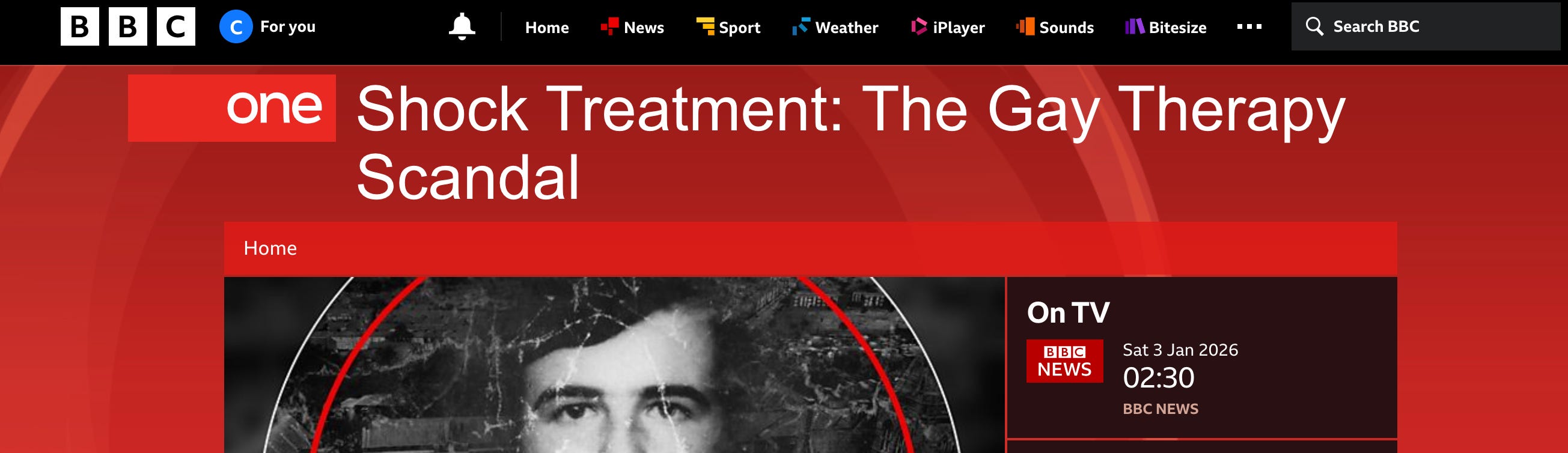
It also clear from other sources that aversion therapy was confined to the margins of psychiatry, and was never accepted as mainstream medical practice, hence its rapid demise and disappearance. However disturbing these historic accounts are, they are completely irrelevant to current debates about conversion therapy for gay and trans people.
And here’s the rub. The movement to ban conversion therapy (itself a contradiction in terms) rests on two false equivalences. The first false equivalence is that sexual orientation and gender identity are somehow equivalent characteristics, parallel hallmarks of oppression. However, sexual orientation is an ordinary part of the spectrum of human sexuality. Gender identity is a self-declared status, and therefore ultimately a belief system, which has no known or agreed defining criteria.
Gender identity depends absolutely upon social affirmation and validation to survive, not least in the therapy consulting room. Hence the intense pressure on therapists to share their personal pronouns, sport rainbow lanyards and host trans-friendly posters. Failure to overtly ‘affirm’ a trans client puts any therapist at risk of professional ostracism by colleagues, or of client complaint and subsequent dismissal by Stonewall-indoctrinated employers.

This is the reality now facing therapists in many parts of the US, under the cosh of state-wide conversion therapy bans.
The second false equivalence is the equation by many trans activists of mainstream exploratory therapy (the bread and butter of any reputable therapist) with conversion therapy. A therapist’s exploration with the client is misinterpreted as an attempt to undermine, challenge or contest the client’s fixed belief, whether child or adult, that their own sense of their gender identity is at odds with the physical reality of their stubbornly sexed physical body.
Therapists actively trying to change their gay or lesbian client in terms of sexual orientation are probably very thin on the ground these days. Therapists seeking to explore a client’s gender identity, together with the potent mix of background factors, such as autism, depression, eating disorders, anxiety and past sexual abuse, are just doing their job, by trying to understand what is going on for the client.
For a trans client, often with a highly fragile sense of self, such exploration is perceived as psychic attack and coercive, if not full-blown conversion, therapy.
For politicians dead-set on bringing in a criminal legal ban on conversion therapy, the problems are legion and the electoral rewards, other than short-lived adulation by the trans lobby, will be very few indeed. At a similar juncture four years ago, The Economist adroitly summarised a series of overwhelming bumps in the road ahead for legislators: “conflation of gay and trans identities; a poor evidence base; and the introduction of ‘gender identity’ into law.”
As if this wasn’t enough to deter any MP with a weather eye on the future, we could add the problem of how a conversion therapy ban will clash with the pressing needs of detransitioners, who often sincerely do want help from therapists in finally ditching their mismatched sense of gender identity, however defined.
And, last but not least, a conversion therapy ban is arguably directly incompatible with the government’s major policy commitment of implementing the Cass Review, which explicitly defends the role of exploratory therapy in working with gender questioning children.
As citizens, we currently seem condemned to live in interesting times; perhaps the task facing politicians is not to make these times even more interesting and unworkable than really is strictly necessary.