
When Journalism Presents Contested Beliefs as Settled Facts: Féile, Labour Women's Conference and Sophie Cunningham
A weekly round-up of stories that raised questions about accuracy, impartiality and trust in journalism | 27 July–2 August 2026

Journalism’s role is not to resolve contested public debates. It is to report them accurately, fairly and in a way that allows audiences to reach their own conclusions.
That means distinguishing between fact, opinion and contested belief.
Increasingly, however, those distinctions appear to be blurring.
This week brought several notable examples of journalists presenting contested beliefs as though they were settled facts.
Féile an Phobail: When Journalists Frame Opinion As Fact
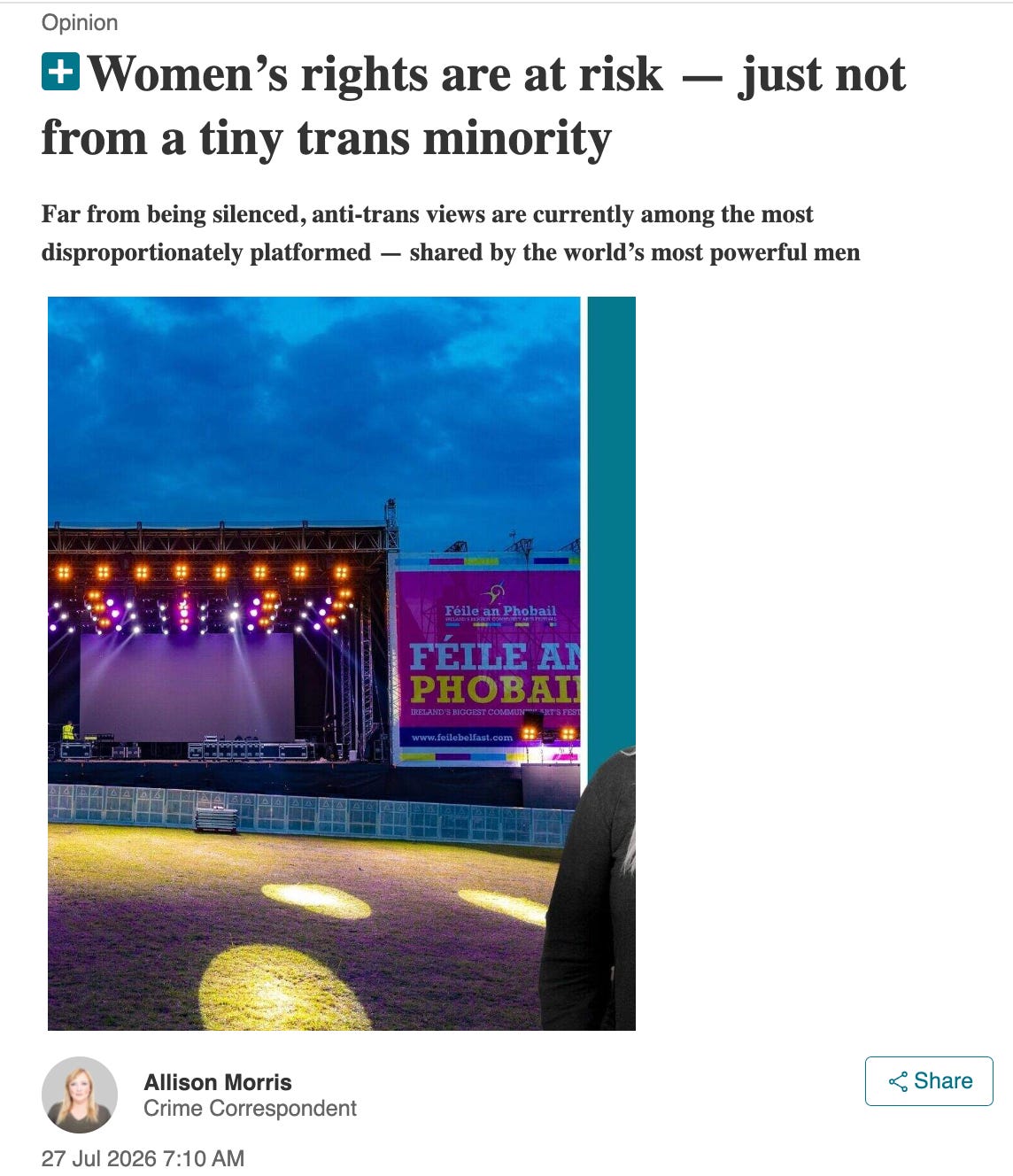
Belfast Telegraph journalist Allison Morris appeared on BBC Radio Ulster this week to discuss the cancellation of a Women’s Rights Network event at Belfast’s publicly funded Féile an Phobail festival. Speaking opposite her was Helen Joyce, Director of Advocacy at Sex Matters, who had been due to appear at the cancelled event.
Morris was defending her recent Belfast Telegraph column, in which she accused women campaigning for sex-based rights of “obsessing” over a tiny trans minority and described them as an “online sectarian mob”.
During the discussion, she repeatedly associated women defending single-sex spaces with the far right, anti-migrant activists, Donald Trump and Elon Musk. She also claimed that J.K. Rowling was funding legal action against Féile - a claim contradicted by a statement from Women’s Rights Network read out by the presenter.
Among the descriptions used were:
“Thuggish, sectarian, right-wing accounts.”
“You couldn’t get a sheet of paper between them and the far right.”
“They don’t want your kind of toxic gender ideology at their festival.”
“They were the same people cheering on attacks on migrants.”
“I’d be embarrassed if my political allies were Elon Musk and Donald Trump.”
These were serious characterisations of people holding lawful beliefs. Yet they were largely presented without challenge or supporting evidence.
One exchange was particularly revealing.
When Joyce suggested journalists should check their facts before publishing opinion pieces, Morris replied:
“We don’t interview people for opinion articles.”
Opinion journalism undoubtedly allows writers to take a position. But it does not remove the responsibility to ensure factual accuracy, represent opposing arguments fairly or distinguish between evidence and assertion.
Metro and Labour Women’s Conference: Accuracy Matters
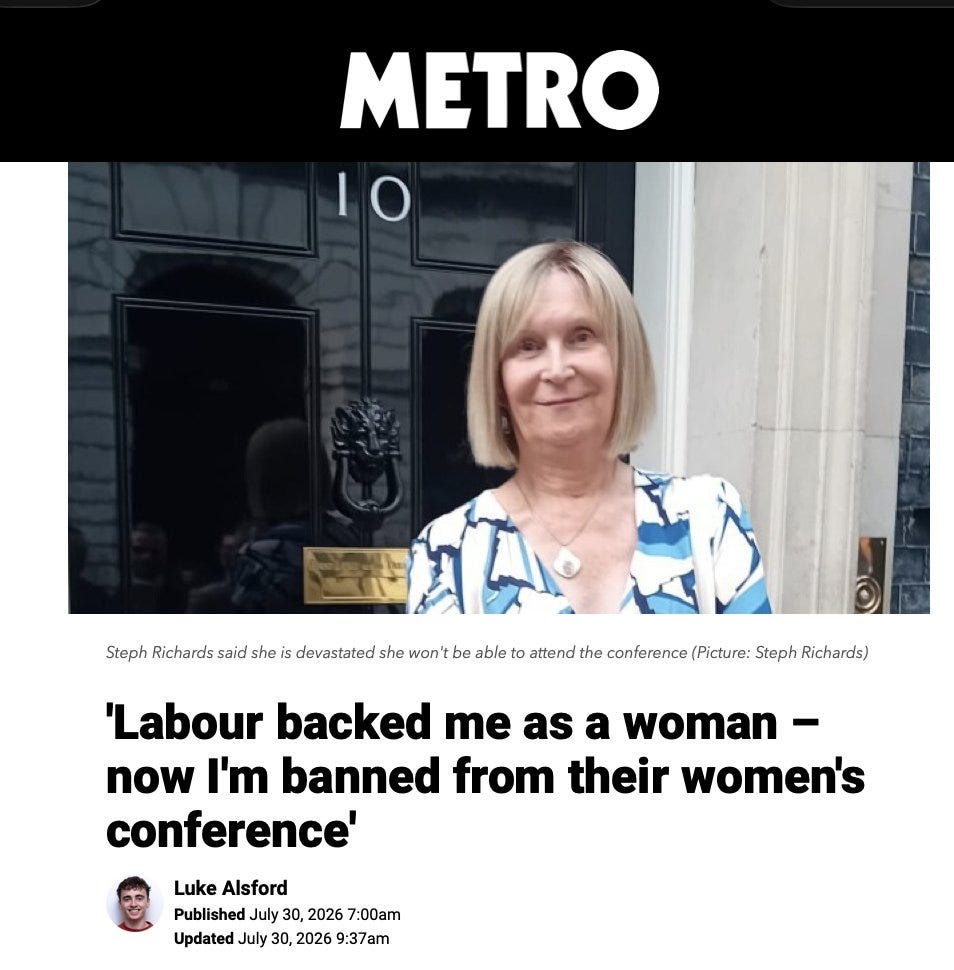
Metro’s reporting of Labour’s Women’s Conference provided another example of contested beliefs being presented as settled fact.
The article stated that Steph Richards was excluded from the conference because he is “trans”. But that is not the basis on which the conference rules operate.
Following last year’s Supreme Court judgment, the formal proceedings are restricted to women, with “woman” and “sex” in the Equality Act referring to biological sex. Eligibility is therefore determined by sex, rather than transgender identity.
The article also referred to Richards’ “biological sex assigned at birth” - language that is both ideologically contested and absent from the Supreme Court’s judgment. Sex is observed and recorded at birth, not assigned.
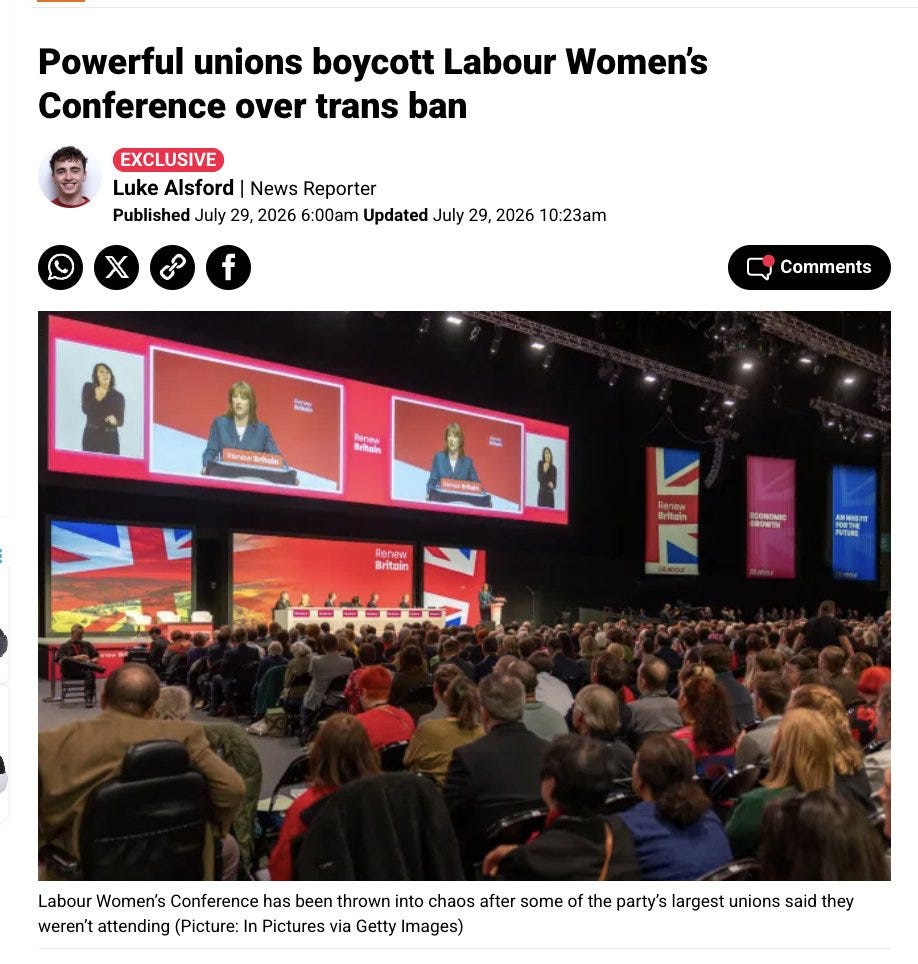
In a follow-up article about trade unions boycotting the event, Metro quoted four unions supporting the boycott alongside two transgender advocacy organisations.
Yet it did not seek comment from any organisation able to explain the rationale for a women-only conference or why some women support maintaining female-only political spaces.
Balance does not require giving equal weight to every viewpoint. But where a story concerns a contested legal and political issue, readers should be given enough information to understand why reasonable people disagree.
Six voices from one side of the debate and none from the other falls well short of that standard.
The Telegraph and Sophie Cunningham: When Headlines Frame the Story
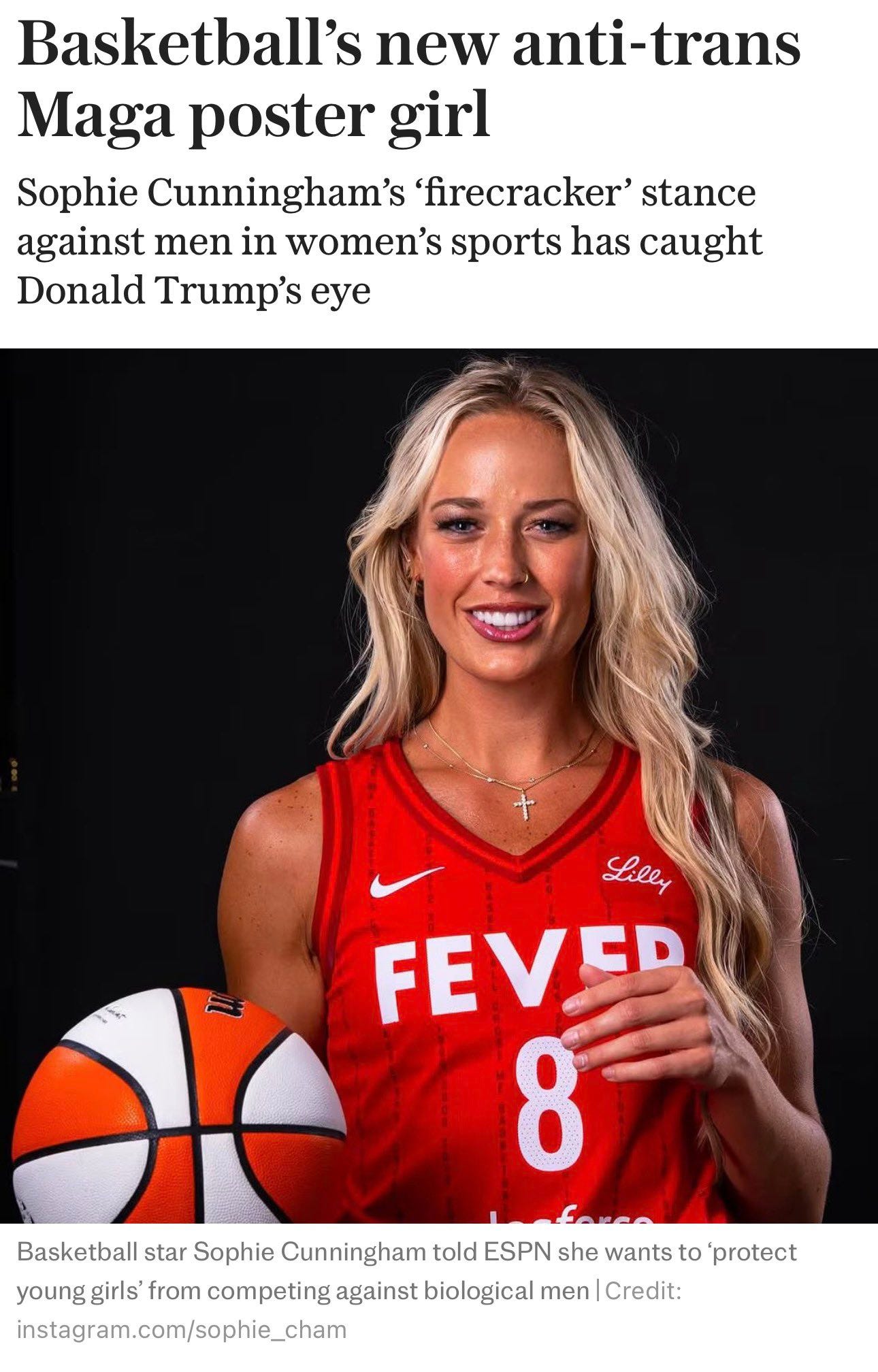
The Telegraph’s reporting on American basketball player Sophie Cunningham was considerably fairer than its headline suggested.
Describing Cunningham as basketball’s new “anti-trans Maga poster girl” is hardly a neutral summary of her position. Readers are encouraged to view her through a political lens before hearing her argument.
A more accurate description of Cunningham might be an athlete who argues that women’s sport should remain female-only.
Instead, the headline took a more provocative framing.
The reporting itself was much stronger.
Readers heard Cunningham’s own words, alongside the arguments of both critics and supporters. Whatever readers make of her views, they were given the information needed to reach their own conclusions.
Headlines matter. In this case, the journalism proved considerably more balanced than the framing that introduced it.
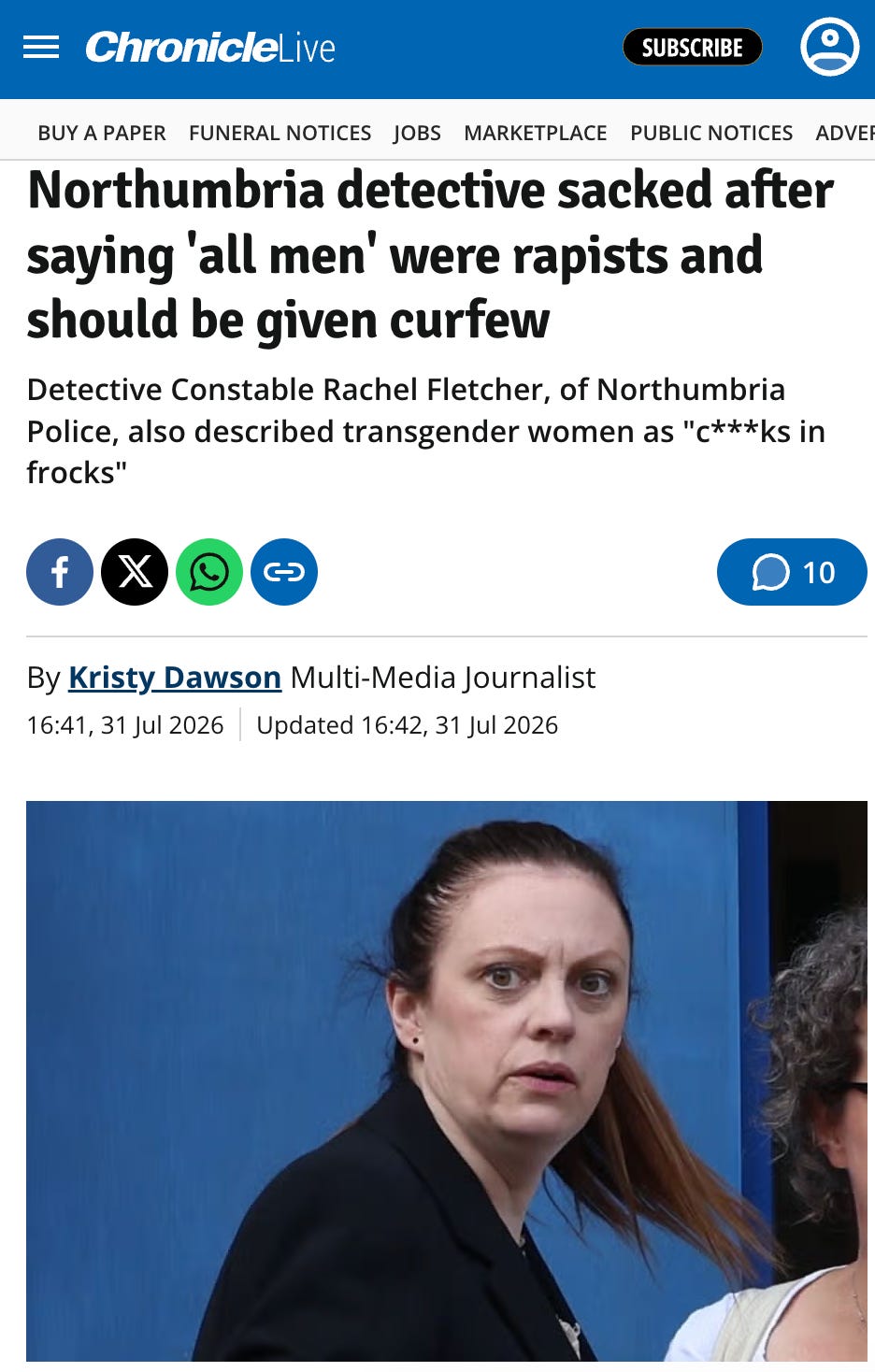
Northumbria Police: A Significant Story Receiving Little Attention
The dismissal of Northumbria Police Detective Constable Rachel Fletcher following a gross misconduct hearing has, so far, received remarkably little media attention.
At the time of writing, we’ve found only one substantive report of the hearing, despite it raising issues that extend beyond the conduct of one officer.
The Women’s Rights Network argues the case raises wider questions about police culture, gender-related policies and the treatment of officers who challenge them. Those claims deserve careful scrutiny, as does the panel’s reasoning.
The written determination has not yet been published. When it is, it should provide a clearer picture of which allegations were proved, how the evidence was assessed and why the panel reached its conclusions.
We’ll be reading the written determination carefully - and watching to see whether this significant case receives the wider media attention it has so far lacked.
Help us hold the media to account
Have you spotted reporting in which activism appears to be taking the place of accurate, impartial journalism? Send examples to contact@seeninjournalism.com.
And if you value our work, please consider becoming a paid subscriber. Your support helps us scrutinise media coverage, challenge poor journalistic practice and promote accurate, evidence-based reporting.
Thank you SEEN for providing the evidence based truth behind the story, when other reporters are so lazy they can't be bothered.
MJ Murphy did an excellent and thorough analysis of the Allison Morris v Helen Joyce radio debate: https://m.youtube.com/watch?v=tSngK2PaAXQ