
Why Are Journalists Still Afraid of Trans People? BBC Three Counties, LBC and Jeremy Vine (Channel 5)
A weekly round-up of stories that raised questions about accuracy, impartiality and trust in journalism | 3–9 August 2026

The introduction of the new statutory EHRC Code on single-sex spaces last week felt like a test for journalists.
Following last year’s Supreme Court judgment, which clarified that the words “woman”, “man” and “sex” in the Equality Act refer to biological sex, the long-awaited Code was intended to help organisations understand how to comply with the law.
Its introduction was fiercely contested. Some MPs sought to block it, while trans-rights campaigners described it as “unworkable” and warned of its impact on trans people.
The question for journalists was straightforward: would they explain what the law now requires, or focus instead on the political arguments surrounding it?
We monitored coverage across a range of broadcasters and publications and found a strikingly consistent pattern.
Compliance with the Code was repeatedly framed as a question of kindness, inclusion or personal preference, rather than legal obligation. The “lived experience” of trans-identifying people was often given greater prominence than explaining the legal position, while women directly affected by the changes were frequently absent from the discussion.
Here are some of the week’s most notable examples.
LBC and James O’Brien: Taking the Piss?
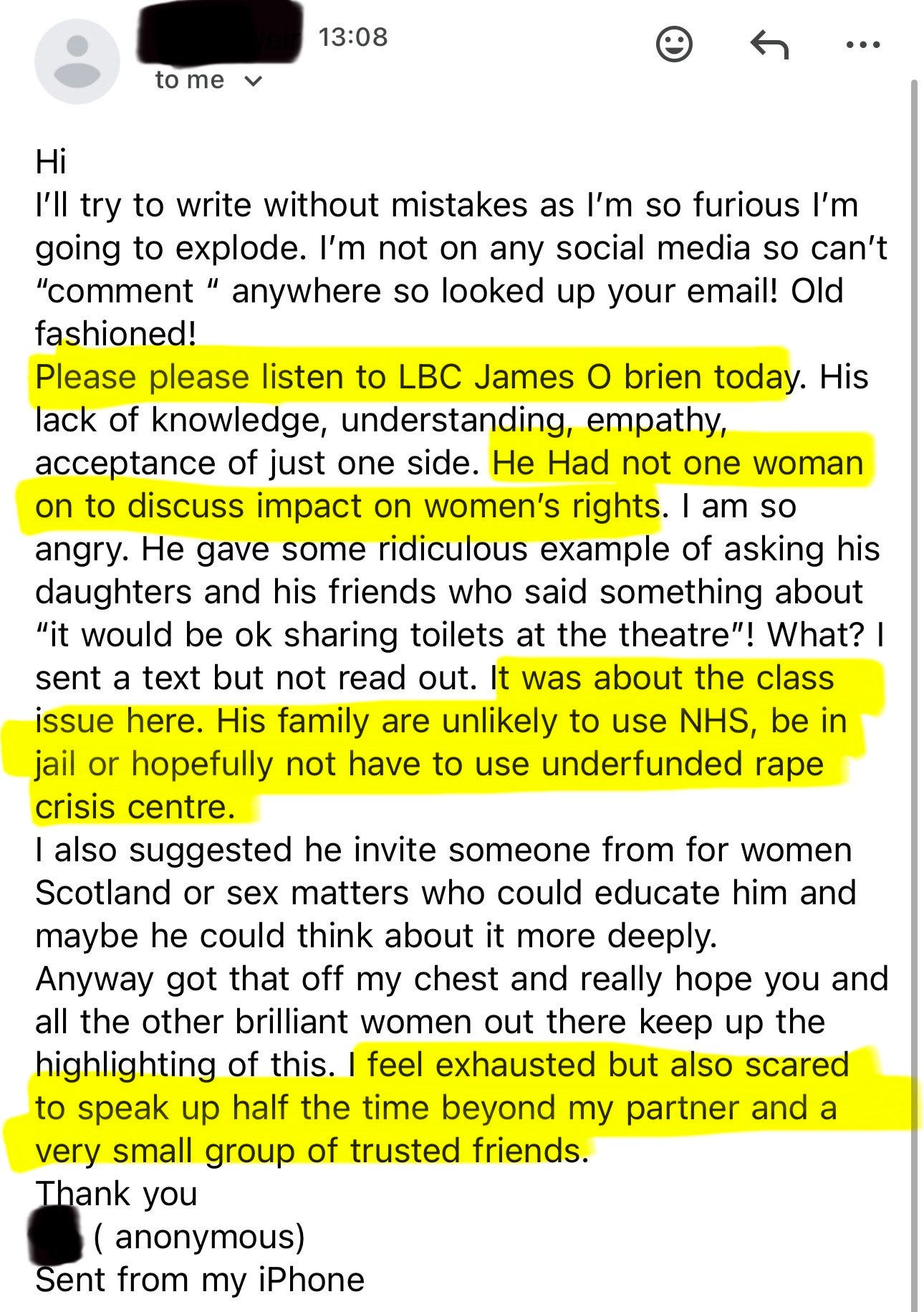
One email we received this week captured the problem with James O’Brien’s coverage of the new EHRC Code.
“Please, please, please listen to James O’Brien today. He had not one woman on to discuss the impact on women’s rights.”
The listener had no journalism training. Yet she instinctively recognised what was missing.
Yet throughout O’Brien’s programme, the discussion focused overwhelmingly on the impact of the new code on trans people. Every caller we heard advanced one of the familiar arguments: that the Code was unworkable, devastating for trans people or would exclude them from public life.
At one point, a trans-identifying caller described wetting themselves outside a public toilet because of the new rules. The obvious follow-up question - why not simply use the facilities corresponding to your biological sex, or a gender-neutral toilet where one was available? - was never asked. O’Brien - who is typically unafraid of challenging his guests - made sympathetic noises.
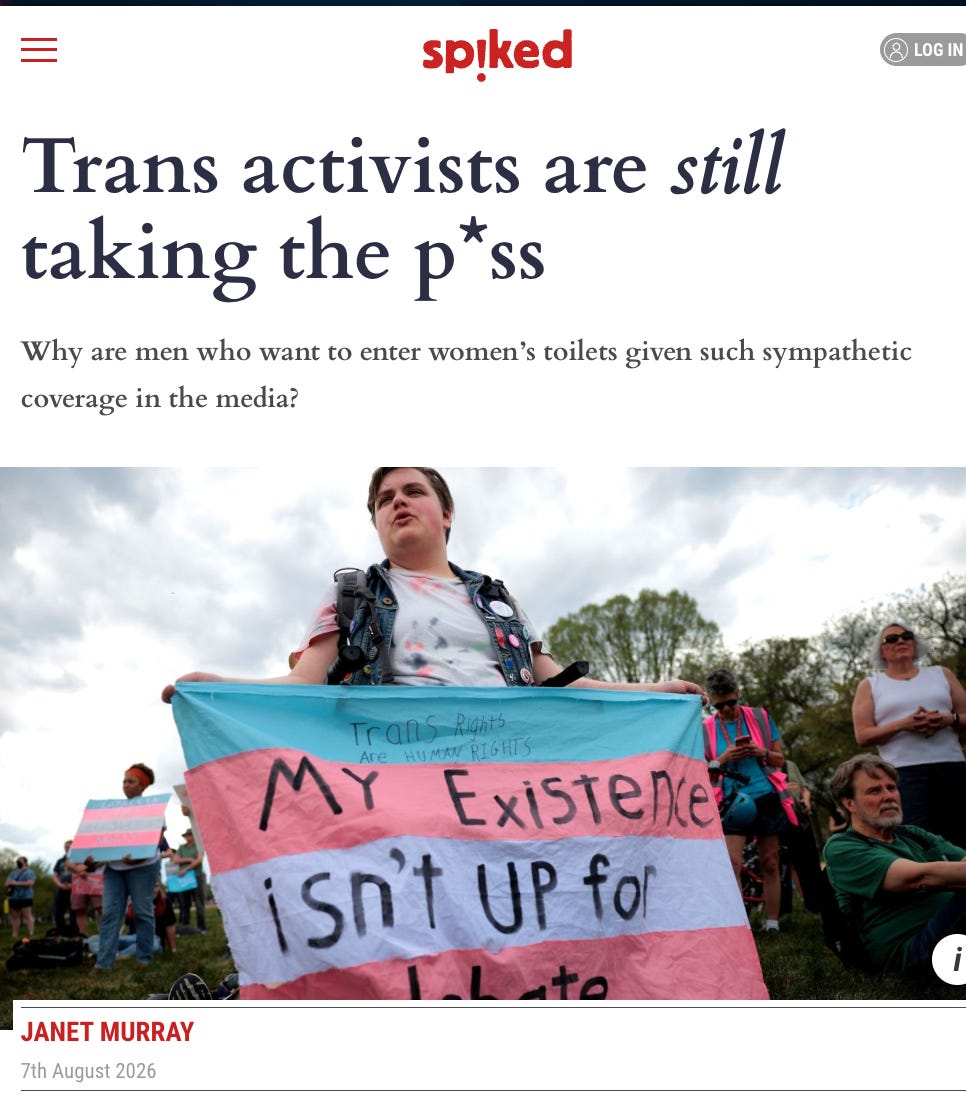
Our direct Janet Murray, wrote about it for Spiked.
Perhaps most strikingly, no woman was invited onto the programme to explain why many support single-sex spaces or why the Supreme Court reached the conclusion it did.
Journalists are under no obligation to agree with the law. But they are under an obligation to explain it accurately, scrutinise claims consistently and ensure audiences hear from those most directly affected by significant legal change.
BBC Three Counties: Three Men, No Female Guest
If LBC largely excluded women from the discussion, BBC Three Counties excluded them almost entirely.
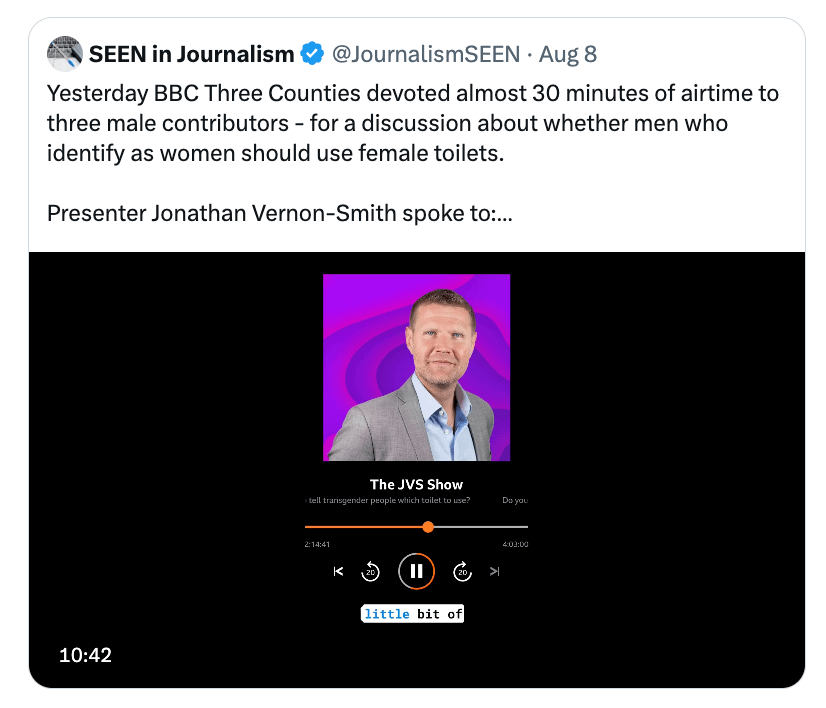
The station devoted almost 30 minutes of airtime to three male contributors discussing whether men who identify as women should use female toilets.
Presenter Jonathan Vernon-Smith interviewed barrister Robin Moira White, TransActual policy manager Nora Padilla and “Michelle” from Watford - a man who said he uses women’s toilets.
No female guest was invited to explain why many women support single-sex spaces.
We’ve since learned that a suitable organisation was approached to take part, but was later told it was no longer needed.
The framing of the discussion was equally revealing.
Before a guest had even spoken, Vernon-Smith asked listeners:
“Is that right, or does that seem unnecessarily unkind and mean?”
He also apologised in advance in case he used language that might be considered offensive during the discussion, before later repeating a similar warning to a caller.
Yet it is not offensive to state the truth. Saying that a man is a man is factually correct.
Those opening moments framed the discussion before a single argument had been heard - presenting compliance with a statutory Code as a question of kindness and factual language as something potentially requiring an apology.
We’ve written in more detail about the programme, including its framing, the absence of female contributors and a number of significant claims that went largely unchallenged.
You can read our X posts about this BBC Three Counties programme below:
Jeremy Vine: From Legal Clarity to ‘Muddling Through’
Jeremy Vine’s Channel 5 programme began well. Vine correctly explained that the new EHRC Code meant single-sex toilets and changing rooms should be used according to biological sex.
But as the discussion progressed, that legal clarity quickly became blurred.
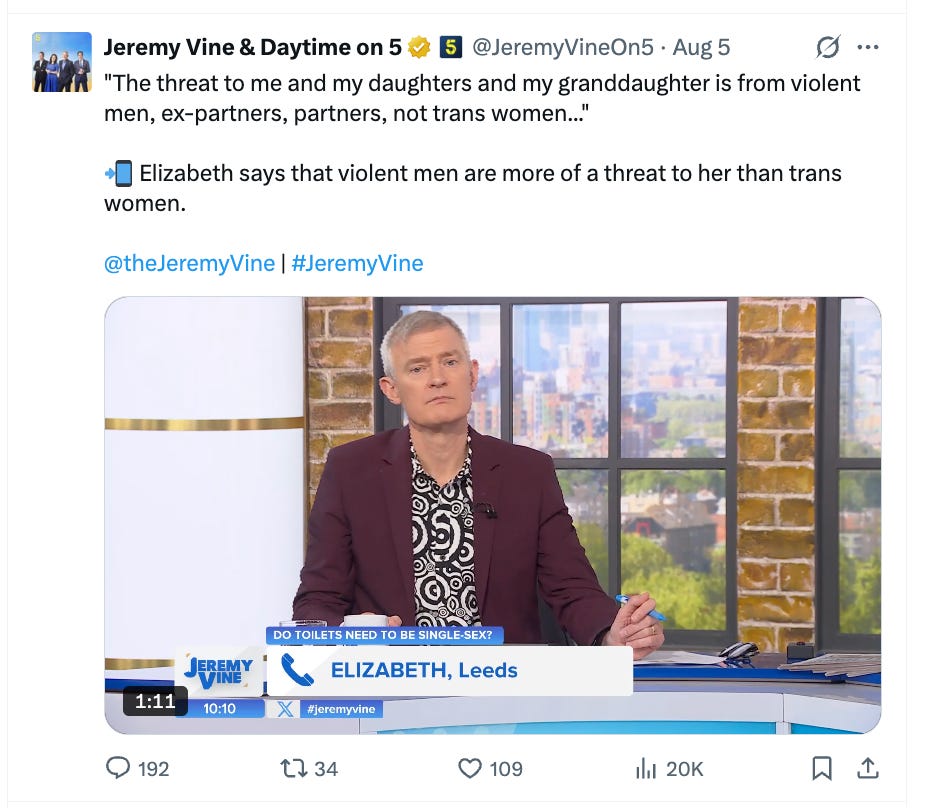
A caller expressed concern about her daughter, who identifies as male, having to use the girls’ toilets. Vine’s trans-identifying guest, Stephanie Lynnette, appeared to suggest that the protected characteristic of gender reassignment meant this would not necessarily be the case.
That claim went uncorrected. Carole Malone was given space to defend single-sex provision and Vine did challenge his guest at points. But, as with several other programmes we monitored, the discussion largely focused on the impact of the changes on trans people, rather than why the law requires single-sex spaces in the first place.
Perhaps the most revealing moment came at the end of the programme, when Vine suggested that perhaps everyone would simply have to “muddle through” - apparently meaning Stephanie could continue using whichever toilet she chose.
That sat uneasily alongside the legal position he had outlined at the start of the discussion.
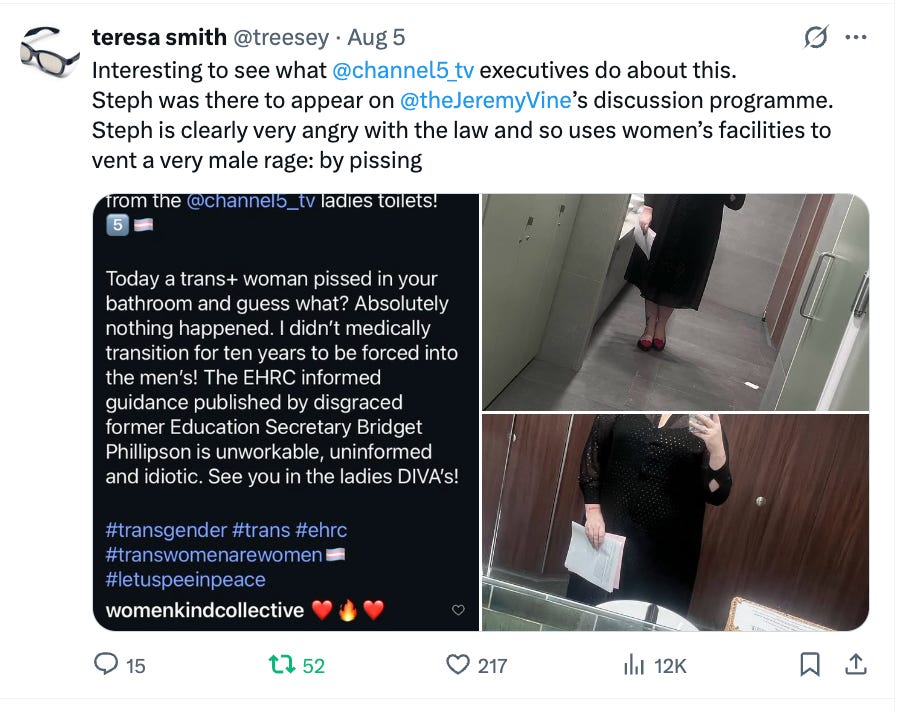
Shortly afterwards, Stephanie posted photographs from inside Channel 5’s women’s toilets with the caption:
“Today a trans+ woman pissed in your bathroom and guess what? Absolutely nothing happened.”
This was no longer a discussion about the law. It had become an act of political defiance.
The Bigger Picture
None of this means journalists must agree with the Supreme Court or support the EHRC Code.
But they should explain the law accurately, scrutinise claims consistently and ensure those most affected are properly heard. They should also not be afraid to ask trans-identifying contributors the same challenging questions they would ask any other guest.
Too often last week, the “lived experience” of trans-identifying contributors took precedence over explaining the legal position, while women’s voices were missing altogether.
Good journalism isn’t about helping audiences arrive at a preferred conclusion. It’s about giving them the facts they need to reach their own.
Help us hold the media to account
Have you spotted reporting in which activism appears to be taking the place of accurate, impartial journalism? Send examples to contact@seeninjournalism.com.
And if you value our work, please consider becoming a paid subscriber. Your support helps us scrutinise media coverage, challenge poor journalistic practice and promote accurate, evidence-based reporting.
Great piece.
The Lamestream have no shame!!
We need citizen journalists. Oh, hold on a minute 😀
Have cross posted
https://dustymasterson.substack.com/p/mona-lisa-a41
Keep up the great work
Dusty